
Copy Trading Account Setup: What to Buy, What to Configure and What It Costs
Adding copy trading is partly a purchase and partly a configuration job. You need the right tools, the right account structure and a fee model that works. This guide sets out what to buy, what to configure and where costs hide.
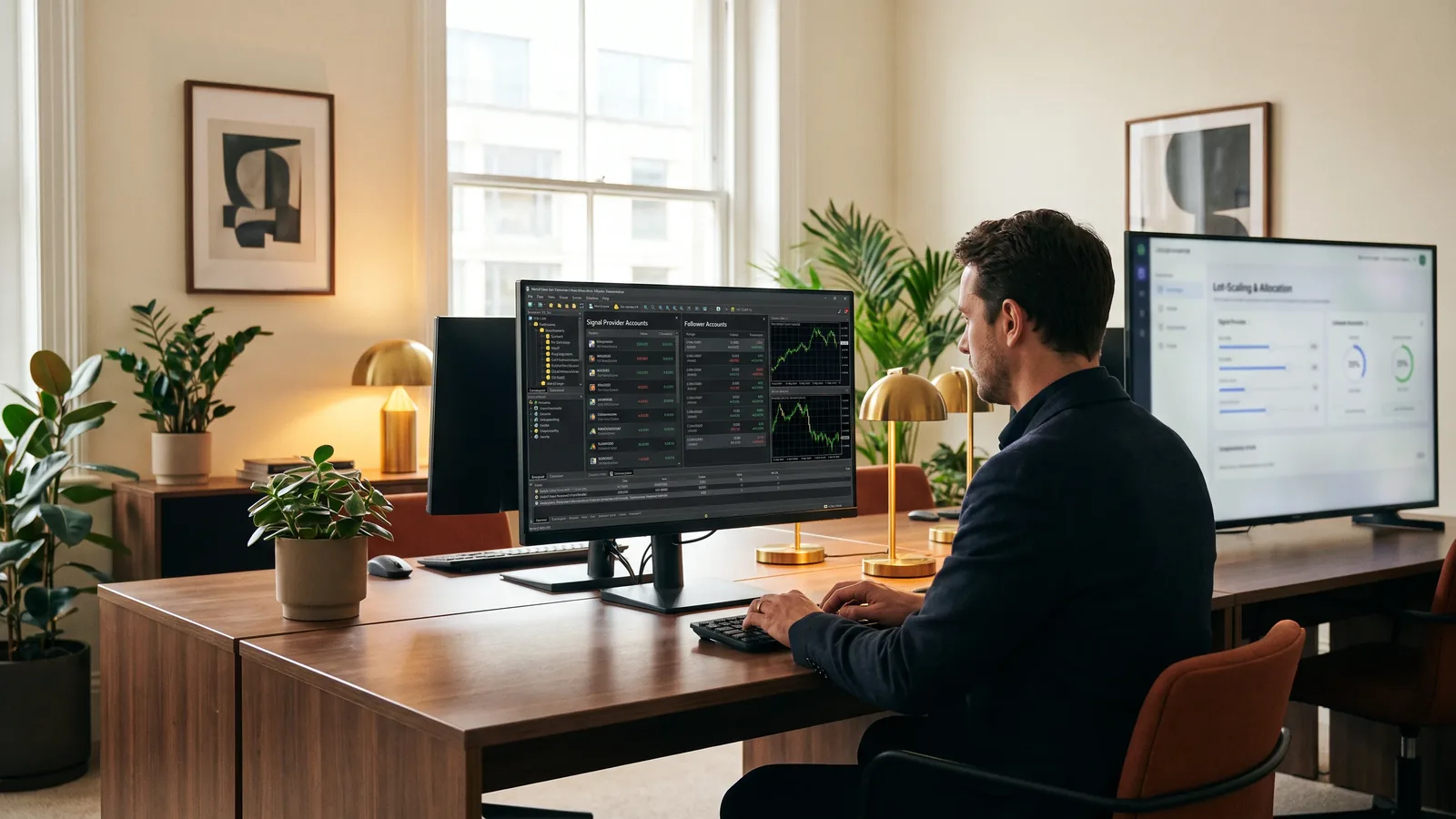
Decide whether you are buying or building
Some platforms offer built-in signal features, and some brokers add a dedicated copy trading plugin or service. Ask your provider what is included in your setup and what is a paid add-on.
Get the answer before you plan the service, because it changes both cost and features.
Account structure to configure
Plan separate trading groups for signal providers and followers, each with its own rules. Keep the names plain so support can explain them. See the full configuration in our copy trading risk controls guide.
Limits and protections
Set defaults before launch: a maximum lot size, an exposure cap, a drawdown stop and rules for delayed or slipped copies. Most followers never change defaults, so they decide the real risk.
The fee model
Choose how providers are paid: performance fees, subscriptions or a mix. Make sure your CRM and payment flow can calculate, record and pay them. If not, add the cost of building or buying that capability to your budget.
Costs buyers forget
- Testing time with demo and small live accounts.
- Support training for a new type of client question.
- Legal review of terms, disclosures and fee wording.
- Monitoring tools for provider behaviour.
Compare this model with pooled alternatives in copy trading versus PAMM/MAM.
What to ask the vendor in the first call
- Which copy trading features are included in my current setup?
- Which are paid add-ons, and what do they cost per month?
- Can I set follower limits and provider rules myself?
- How are fees calculated, and where do they appear?
- What happens to followers if a provider is removed?
Write the answers into your purchase file before comparing alternatives.
A buyer’s feature checklist
Before you buy or build a copy trading service, list the features you need and mark what each option offers.
| Feature | Vendor A | Vendor B | Build ourselves |
|---|---|---|---|
| Provider and follower account types | |||
| Scaling methods (proportional, fixed) | |||
| Exposure and drawdown limits | |||
| Fee models (performance, subscription) | |||
| Provider vetting tools | |||
| Follower dashboard | |||
| Reporting and statements | |||
| Integration with CRM |
A row you cannot fill is a question for the vendor.
A worked example of a cost comparison
A buyer compares buying a copy trading module with building one. The module has a monthly fee and a setup charge. Building has no licence fee but needs developer time, testing and ongoing maintenance. After estimating hours and adding a margin for unknowns, the buyer finds that the cost over three years is similar, but buying is faster and carries less risk.
The buyer chooses to buy and keeps the saved time for provider recruitment, which is where the service will be won or lost. The numbers were illustrative, but the reasoning is real: compare cost, time and risk together.
Testing in a trial
Ask for a trial environment and test scenarios: a provider opens and closes trades, a follower with a small balance copies, a follower hits a drawdown limit, a symbol is unavailable and a provider stops. Record what happens each time.
If the vendor will not allow a trial, ask for a demonstration with your scenarios. A product that has been built carefully can handle a test.
Costs buyers forget
- Time to recruit and vet providers.
- Marketing and education for followers.
- Support for the extra questions that copy trading generates.
- Monitoring of execution quality.
- Legal and compliance review.
Add them to the budget so that the service pays for itself in practice, not only on paper.
What to ask when you buy a copy trading module
Ask which scaling methods are supported, how rounding is handled, what happens when a follower lacks margin, how partial fills are treated, which limits are configurable and how fees are calculated and reported. Ask for a demonstration of each with test accounts.
Also ask about data: can you export all trades, fees and follower actions, and how long are they kept? Good records protect you in disputes and help you explain the service to regulators and partners.
Support and updates
Copy trading touches many accounts at once, so a failure is multiplied. Ask about the support route for urgent issues, how updates are tested and announced and whether you can delay an update until you have checked it. A vendor with a clear update policy treats your clients’ money with care.
Add the cost of an upgraded support plan if you expect heavy use.
A buyer’s launch plan
Plan a small launch: a handful of providers, a limited group of followers and close monitoring. Prepare the disclosure pages, test the failure cases and brief the support team. After a month, review the data and decide whether to expand. A modest start gives you evidence and protects your reputation.
Limits and protections to ask about
Ask which limits the module supports: maximum exposure per provider, maximum drawdown per follower, minimum balance, maximum number of open trades and restrictions on instruments. Ask whether limits can be set per provider or only globally, and whether followers can set their own within your bounds.
Followers value control, and brokers value protection. A module that balances both is easier to explain and safer to run.
Asking for a copy of the documentation
Ask the vendor for the configuration and operation documents for the module: setup steps, parameter explanations, limits, fee rules and troubleshooting. Review them with your team and compare them with your plan.
Good documentation is a sign of a well-built product and makes onboarding your staff much easier.
Frequently asked questions
Should I buy or build copy trading?
Compare cost, time and risk over three years. Many brokers buy and spend their effort on providers and service.
What fee models are typical?
Performance fees, subscription fees and volume-based fees are common. Choose one you can explain clearly.
How do I protect followers?
With limits, provider vetting, clear disclosure and monitoring. See our risk controls guide.
Is a trial available?
Ask. A trial or a live demonstration with your scenarios is reasonable to request.